memento vivere

.

Memento vivere is a prospective research project that blends contemporary creation and social science research. It continues our previous work on the living and vitalities, from a new perspective. For art remains a powerful tool for reframing our lives, situating them in their proper context within the long-term course of humanization and the great cycle of life.

In particular, it can help us recognize how much past generations compose our matrix, how we still lead our lives accompanied by their words and with their tools. This is how they socialize and humanize us. This is a perennial social function, that is, one that is active in the world of the living. No civilization would exist without this transmission of words and knowledge, symbols and tools. There is nothing necrophiliac in this research, but rather, in the era of the Anthropocene and the collapse of ecosystem balances, the desire to question and reframe our lives, to situate them in their proper context within the long-term course of humanization and the tangled dynamics of life

  • Two contemporary works will be open to the public in November 2025 at the Petit Sablon cemetery in the commune of La Tronche : Les Présences by Philippe Mouillon, and La Moire by Mathilde and Nicolas Beguin.
  • Then a series of encounters will take place at the Grenoble museum on Saturday, November 8, 2025, from 11 a.m. to 5 p.m.:
> Conversations: at the Grenoble Museum

The LABORATOIRE and the Grenoble Museum are offering a series of conversations on Saturday, November 8, about the place of the dead in the world of the living. These conversations will involve authors and artists whose work questions our mortal condition, practitioners who are confronted daily with death or its accompaniment, and the public:

  • Julia Champey, anesthesiologist and intensive care physician, head of the Grenoble branch of the Medical Humanities Chair at the GHU Psychiatry – Neurosciences / Sorbonne, directed by Cynthia Fleury
  • Rachid Koraichi, visual artist, author of Jardin d’Afrique in Zarzis, Tunisia, a cemetery intended to house the anonymous bodies of migrants who died at sea
  • Pierre Reboul, writer, author of Haiku from the Threshold of Death and Petites chroniques d’un carré commun, member of the collective Morts de rue et personnesisolers de Grenoble to accompany the funerals in the Carré commun of the homeless and Disaffiliated
  • Jehanne Roul, lecturer in medieval history at UCO Angers. Her research focuses on beings and their remains—such as relics or the dead on the battlefield.
  • Raphaëlle Guidée, professor of comparative literature at the University of Paris 8, works on mourning, memory, and mass violence, and is the author of The City After. Detroit, a narrative investigation and The Apocalypse, a political imagination
  • Daniel Bougnoux, philosopher, is currently exploring forms of life
  • Pascaline Thiolliere, architect, researcher on spaces of coexistence with the dead and the spatiality of mourning, at the Cresson laboratory, ENSA Grenoble-UGA
  • Jacques Grison, photographer, author of a long-term research project on the landscapes of the Verdun battlefields
  • Arnaud Petit, performer, composer, and conductor, author of operas, oratorios, and works combining music and narrative, including Memories, about the presence of the missing
  • Mathilde Béguin, visual architect, and Nicolas Béguin, cabinetmaker designer, authors of La Moire
  • Philippe Mouillon, visual artist, creator of Memento vivere, and author of Légende(s), composed with Maryvonne Arnaud in Sarajevo besieged

The Grenoble Museum thus revives a long tradition of art history, to which its collections bear witness, from Egyptian antiquities to the present day.

With the support of the Ministry of Culture (Drac Auvergne Rhône-Alpes), the Auvergne Rhône-Alpes region – within the framework of the 21st Century Memories calls for projects, the Department of Isère, the City of La Tronche and the city and Museum of Grenoble.

More about >


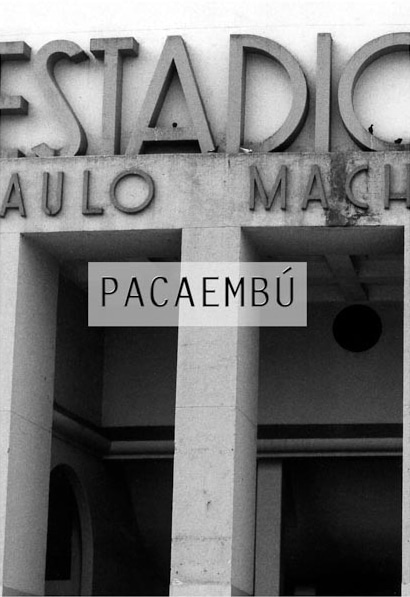
pacaembu


64 pages / http://lelaboratoire.net/wp-content/themes/laboratoire/bon-de-commande.pdf

publishing Laboratoire

15€

Original texts by Luís Avelima, Pierre Sansot, Yves Chalas

Original images by Abderrazak Sahli (Tunisia), Agnès Thurnaeur (France), Akari Hironaga (Japan), Akiko Arai (Japan), Akio Hosono (Japan), Ali Mroivili dit Napalo (Comores), Alice Vinagre (Brazil), Amelia Toledo (Brazil), Andréa Lanna (Brazil), Anna Bella Geiger (Brazil), Antoine Perpere (France), Antonio Maia (Brazil), Avatar Moraes (Brazil), Barthélémy Toguo Tamokoué (Cameroon), Ben (France), Bill Baker (Canada), Braïma Injai (Guinea Bissau / France), Burhan Dogancay (Turkey / USA), C.K.Rajan (India), Carlos Martins (Brazil), Carlos Vergara (Brazil), Chiba Naoko (Japan), Chico Cunha (Brazil), Christine Monceau (France), Cildo Oliveira (Brazil), Clara Fajardo (Brazil), Claudia Cuesta (Colombia / Canada), Claudio Tozzi (Brazil), D.Nicola Durvasula (England / India), Daniel Laskarin (Canada), David Koloane (South Africa), Dina Balona (Greece), Do-Ho Suh (Corea), Dorrit Yacoby (Israel), Emmanuel Nassar (Brazil), Ene Kull (Estonia), Eugênia Harten (Brazil), Farid Belkahia (Morocco), Fodé Camara (Senegal), Forns Bada (Spain), François Kiéné (France), Gabriela Machado (Brazil), Geng JianYi (China), Gonçalo Ivo (Brazil), Goya Lopes (Brazil), Gülsun Karamustafa (Turkey), Hélène Agufroy (France), Huang Yong Ping (China / France), Issa Kouyate (Ivory Coast), Issa Samb (Senegal), Jacqueline Fabien (Martinique), Jeong Hwa Choi (Corea), John Nicholson (USA / Brazil), Jorge Bassani (Brazil), José Luiz de Pellegrin (Brazil), José Patricio (Brazil), Jozef Legrand (Belgium / Germany), Julian Gandia (Spain), Kan-si (Senegal), Kong Sung-Hun (Corea), Kriki (France), Leonid Borisov (Russia), Lia do Rio (Brazil), Ligia Lippi (Brazil), Liu AnPing (China / Germany), Liz Rideal (Great-Britain), Lu Sheng-Zhong (China), Luiz Aquila da Rocha Miranda (Brazil), Mahdjoub Ben Bella (Algeria / France), Malia Barron Hendricks (Hawaï / USA), Manisha Parekh (India), Marc Verlan (Moldavia), Marcelo Lago (Brazil), Marcia Abreu (Brazil), Márcia Cirne Lima (Brazil), Marco Tulio Resende (Brazil), Marconi Drummond (Brazil), Marcus André (Brazil), Maria do Carmo Secco (Brazil), Maria Tereza Louro (Brazil), Maria Tomaselli (Austria / Brazil), Marie Sester (France), Marilena Zamboura (Greece), Marina Saleme (Brazil), Mario Azevedo (Brazil), Mario Vale (Brazil), Mary Kelly (USA), Maryvonne Arnaud (France), Mauricio Nogueira Lima (Brazil), Mauricio Silva (Brazil), Mickael Bethe-Selassié (Ethiopia / France), Miguel Chevalier (Mexico/ France), Miguel Egaña (France), Miguel Petchkovsky (Angola / Netherland), Moacyr Toledo (Brazil), Modibo Diallo (Mali), Mohamed Haïdara (Mali), Monica Barki (Brazil), Monica Barth (Brazil), Monica Sartori (Brazil), Mustapha Boujemaoui (Morocco), N.S.Harsha (India), Nagashima Tsutomu (Japan), Nancy Willis (USA), Nigel Rolfe (Ireland), Noboru Ishihata (Japan), Orlando Castaño (Brazil), Paiva Brasil (Brazil), Pamela Levy (USA / Israel), Patrice Kalil (France), Philippe Laleu (France), Rachid Koraichi (Algeria), Rania Rangou (Greece), Ray Barrie (USA), Regina Silveira (Brazil), Rekha Rodwittiya (India), Ricardo Homen (Brazil), Ricardo Mattar (Brazil), Richard Prince (Canada), Rieko ABE (Japan), Rinaldo José da Silva (Brazil), Roberto Bethonico (Brazil), Roberto Tavares (Brazil), Rodolfo Athayde (Brazil), Rodrigo de Castro (Brazil) Rose Frain (Great-Britain), Shinya Kigure (Japan), Shirakawa Yoshio (Japan), Shuli Nachshon (Israel), Silvie Defraoui (Switzerland), Stefane Beiu (Moldavia), Sukenari Katsue (Japan), Sumi Wakiro (Japan) Susan Taylor (Great-Britain), Sylvie Fanchon (France), Thereza Miranda (Brazil), Thomas Lawson (Scotland), Tomoyuki Yajima (Japan), Toyo Tsuchiya (Japan / USA), Ubirajara Ribeiro (Brazil), Unkyung Hur (Corea), Urve Eslas (Estonia), Vadim Tallerov (Russia), Veit Stratmann (France), Victor Arruda (Brazil), Vincent Leow Kong Yam (Singapore), Wanda Pimentel (Brazil), Wang Jian-Wei (China), Wang Lu Yan (China), Warren Murfitt (Canada), Wilson Piran (Brazil), Yang Jun (China), Ye Shuguang (China), Ye Xin (China / France), Yin Xiu Zhen (China), Yorgos Nikas (Greece), Yoshio Shirakawa (Japan), Youssouf Bath (Ivory Coast), Yuri Leiderman (Ukrania), Zhou Tiehai (China).
Download the order form

Contemporary & local

« local.contemporain » is a centre of research and original artistic initiatives around contemporary urban territories, an enterprise to renew our look, with a particular care for emerging forms and experiences.

« local.contemporain » examines, in the usual local habits , the innovative particularities or the ones that resist to the global mutations of our societies.

This strategy of hyper-localised questioning is developed with a particular care for the global scale of mutations and for the abundant complexity of the involved temporalities. That is why artists and researchers coming from all over the world are associated to this initiative, looking for numerous urban tools to think about this territory.

We publish an 80-page review distributed in bookstores by Harmonia-Mundi.

Nine issues are published to date: 01> you are here focused on the contemporary realities of ordinary urban forms, 02> It’s Sunday! devoted to the analysis of free time in a so-called “leisure” society, 03> invisible city analyzes sensitive urban forms, those which escape the domination of the eye but structure our perceptions, 04> the precarious, contemporary questions, on the precariousness of our lives as a new dominant form, 05> Crowds centered on the experience of the crowd, alternately worrying or intelligent, 06> Points of reference, around the feeling of disorientation of a growing share of the population , 07> a world of its own or how each one builds its own landmarks in a globalized horizon, 08> collection of collections about the place of privacy in the public space,  09> singular landscapes, pluralistic landscape to approach the Landscape as a resource within reach of all, and live with scope.

> We produce interventions of urban scales in the real space of the city, in order to shape these representations for the man of the street. They invite the participation of hundreds of contributors.

Thus It is Sunday, a random collection of photographs:

> We develop pedagogical tools for teachers from kindergarten to university.

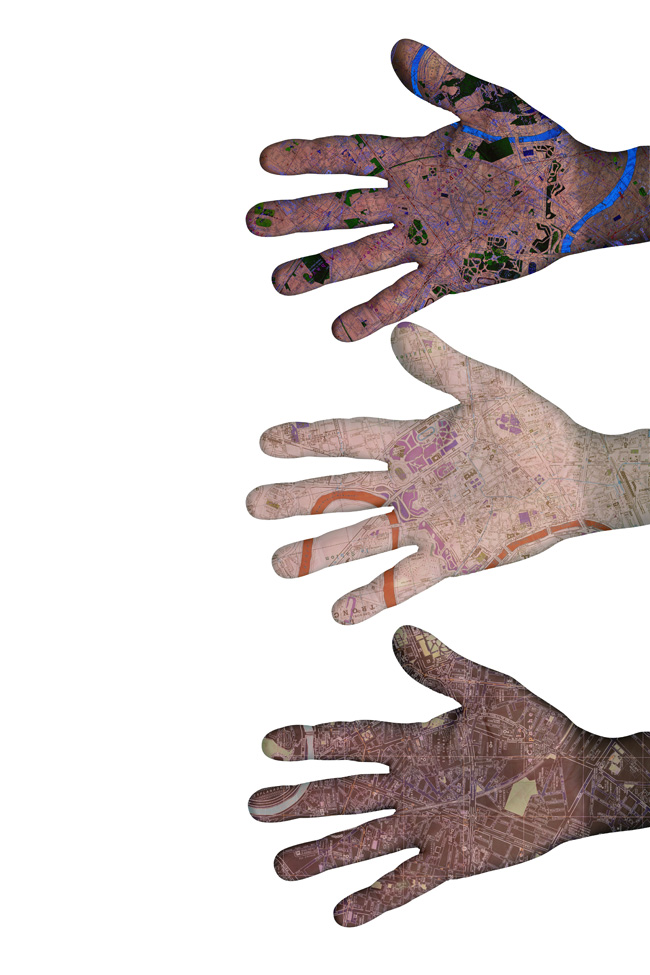
Thus cartographic games:

Visit the site local.contemporain